
PSTN and ISDN withdrawal
The copper network closes on 31 January 2027
Openreach is withdrawing PSTN and ISDN services across the UK. Analogue lines, ISDN circuits and any equipment that signals over them will stop working. We identify every affected circuit and device, then migrate each one to a suitable digital service.
Time remaining until withdrawal
Day(s)
:
Hour(s)
:
Minute(s)
:
Second(s)
Order lead times increase as the deadline approaches.
Background
From PSTN to all-IP
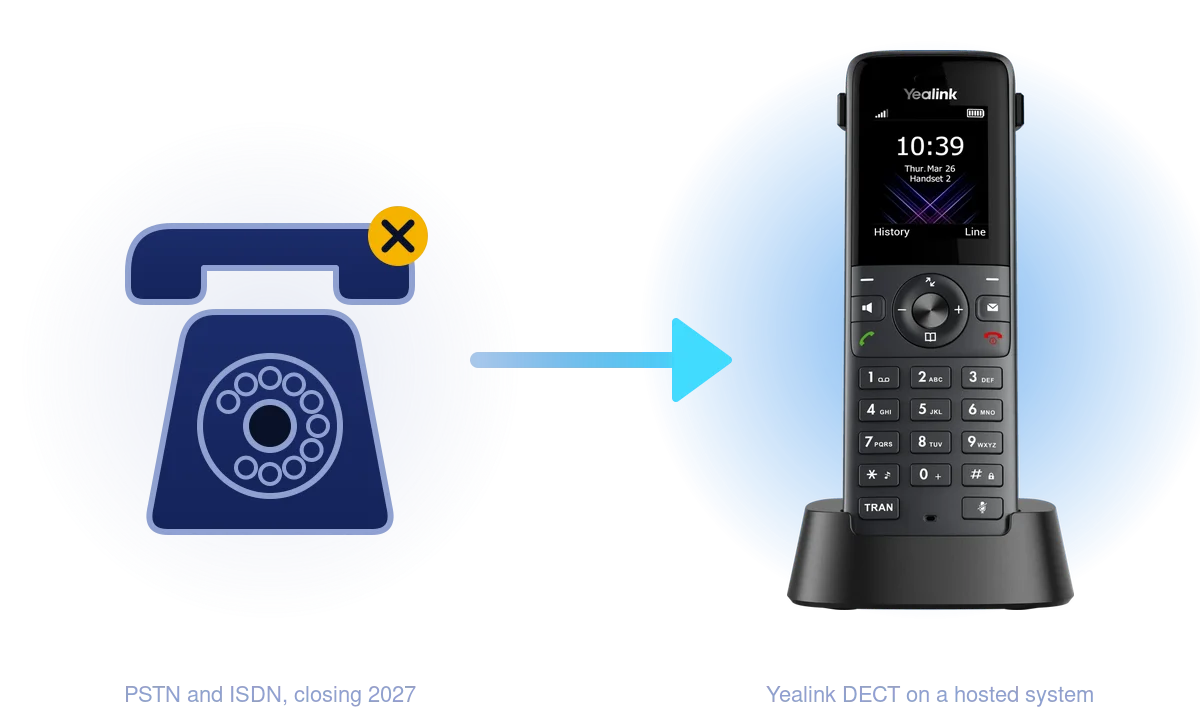
The Public Switched Telephone Network has carried UK voice traffic over copper pairs for decades. Openreach is replacing it with an all-IP network in which voice is carried as data. Services that depend on the PSTN, including analogue lines, ISDN2 and ISDN30, are being withdrawn and will not be converted automatically.
- Analogue and ISDN services withdrawn
- Voice delivered over IP, either hosted or via SIP trunks
- Existing numbers ported to the new service
- Copper-dependent broadband (ADSL, FTTC) replaced by SoGEA, FTTP or 5G
Last checked: 27 October 2026.
Migration reference
Legacy services and their replacements
A summary of the services we most often find on site and the usual digital replacement for each.
| Legacy service | Typical use | Digital replacement |
|---|---|---|
| Analogue PSTN line | Single phone, fax, alarm or payment terminal | Hosted VoIP, SoGEA with an analogue adapter, or a 4G/5G SIM |
| ISDN2 / ISDN30 | Trunks for an on-premises PBX | SIP trunks or a hosted PBX |
| ADSL / FTTC broadband | Internet access | SoGEA, FTTP or 5G business broadband |
| Alarm dialler | Intruder or fire alarm signalling | Dual-path IP and 4G signalling, via your alarm provider |
| Lift emergency line | Lift car telephone | Digital line or 4G lift autodialler |
| Dial-up card terminal | Payment authorisation | Broadband, Wi-Fi or SIM-based terminal |
Equipment approvals vary by manufacturer and insurer. Where certification is required, we work with your alarm and lift maintenance providers.
Site checklist
Equipment commonly affected
Each of the following is often connected to an analogue or ISDN line. If any are present on your premises, they should be included in the migration plan.
Phone lines and ISDN
Analogue lines and ISDN2 or ISDN30 channels will cease to work. Numbers are ported to a hosted platform or to SIP trunks on your existing PBX, so inbound calls continue without interruption.
Intruder and fire alarms
Many alarm diallers signal over an analogue line. Your alarm provider will need to fit or reconfigure an IP or 4G communicator; we can supply the connection it uses.
Payment terminals
Terminals that authorise over a dial-up connection must be moved to broadband, Wi-Fi or a SIM-based connection.
Lift emergency telephones
Lift lines are a safety requirement. They need a digital line or a dedicated 4G autodialler, tested with your lift maintenance company.
Door entry, gates and barriers
Systems that dial out over an analogue line can be moved to a SIM or a VoIP adapter.
Fax and franking machines
Some rely on an analogue line. We will check whether they are still needed and recommend a replacement where required.
Telecare and lone worker devices
Any device that raises an alarm over a phone line must be identified and migrated as a priority.
Broadband delivered over a phone line
ADSL and FTTC services require a PSTN line and will be replaced by SoGEA or FTTP, neither of which needs one.
Free download
Download the switch-off site checklist
A two-page checklist to walk round your premises with before the copper network closes on 31 January 2027.
- Nine types of equipment that commonly rely on an analogue or ISDN line, from alarms to lift phones
- Space to note each line and number, one copy per site
- What to gather before you speak to any provider
Migration process
How we carry out the migration
Circuit audit
Bills reconciled against what is physically installed
Migration plan
Replacement, sequence, cost and porting dates agreed
Staged cutover
Out of hours where required, each device tested
Handover
Updated documentation and ongoing engineer support
Customer story
Keeping an analogue phone system working after a digital upgrade
The problem: The customer’s broadband provider moved their phone line to digital. Their phone system was analogue, with a handset in every room, and it stopped working.
What we did: Surveyed the site straight away, then connected an adapter to the router that converts the digital line back to analogue for the existing phone system. The existing phone system and wiring stayed in place.
The result: Working again within two days.
“An amazing value for money solution.” From the customer’s Google review.
Customer story
Two businesses moved from ISDN to a cloud phone system
The problem: One owner ran two businesses on ISDN lines, a service that is being withdrawn.
What we did: Moved each business onto our cloud phone platform in turn, then supported both afterwards, with queries and changes dealt with quickly.
The result: Both businesses off ISDN and on a modern hosted system well before the switch-off.
“Each time the team have been professional, knowledgeable and have gone the extra mile.” From the customer’s Google review.
FAQs
Frequently asked questions
Will our phone numbers change?
No. Numbers are ported to the new service. Porting dates are agreed in advance and scheduled to avoid disruption.
Do we need to replace our handsets?
Not necessarily. Analogue devices can often be kept using an adapter, but where handsets are near end of life, migrating to a hosted platform is usually more cost-effective in the long run.
What happens if no action is taken?
Copper services will be withdrawn on 31 January 2027. A basic voice line may be migrated by the provider, but alarm diallers, lift lines and payment terminals can fail without notice.
Is our broadband affected?
If it is delivered over a phone line (ADSL or FTTC), yes. It will be replaced by SoGEA or FTTP. Where full fibre is not yet available, 5G business broadband is a practical interim or permanent option.
Can we keep our existing PBX?
Many IP-capable systems can be connected using SIP trunks. We will assess your system's age, support status and licensing before advising whether to keep or replace it.
How long does migration take?
This depends on the number of sites, circuits and devices. Small sites can be completed quickly; multi-site estates are planned in phases. Starting early allows installations to be scheduled at convenient times.
Book a line audit
We will identify every circuit and device affected by the switch-off and provide a written migration plan.
Contact
Book a line audit
Tell us about your site and what is connected to your lines. An engineer will contact you within one working day to arrange the audit, and you will receive a written migration plan afterwards.
5 Acorn Business Centre, Northarbour Road, Portsmouth PO6 3TH
Monday to Friday, 09:00 to 17:15
Out-of-hours support by arrangement